Showing posts with label ketosis. Show all posts

Saturday, January 15, 2011

Do you lose muscle if you lift weights after a 24-hour fast? Probably not if you do that regularly

Compensatory adaptation (CA) is an idea that is useful in the understanding of how the body reacts to inputs like dietary intake of macronutrients and exercise. CA is a complex process, because it involves feedback loops, but it leads to adaptations that are fairly general, applying to a large cross-section of the population.

A joke among software developers is that the computer does exactly what you tell it to do, but not necessarily what you want it to do. Similarly, through CA your body responds exactly to the inputs you give it, but not necessarily in the way you would like it to respond. For example, a moderate caloric deficit may lead to slow body fat loss, while a very high caloric deficit may bring body fat loss to a halt.

Strength training seems to lead to various adaptations, which can be understood through the lens provided by CA. One of them is a dramatic increase in the ability of the body to store glycogen, in both liver and muscle. Glycogen is the main fuel used by muscle during anaerobic exercise. Regular strength training causes, over time, glycogen stores to more than double. And about 2.6 the amount of glycogen is also stored as water.

When one looks bigger and becomes stronger as a result of strength training, that is in no small part due to increases in glycogen and water stored. More glycogen stored in muscle leads to more strength, which is essentially a measure of one’s ability to move a certain amount of weight around. More muscle protein is also associated with more strength.

Thinking in terms of CA, the increase in the body’s ability to store glycogen is to be expected, as long as glycogen stores are depleted and replenished on a regular basis. By doing strength training regularly, you are telling your body that you need a lot of glycogen on a regular basis, and the body responds. But if you do not replenish your glycogen stores on a regular basis, you are also sending your body a conflicting message, which is that dietary sources of the substances used to make glycogen are not readily available. Among the substances that are used to make glycogen, the best seems to be the combination of fructose and glucose that one finds in fruits.

Let us assume a 160-lbs untrained person, John, who stored about 100 g of glycogen in his liver, and about 500 g in his muscle cells, before starting a strength training program. Let us assume, conservatively, that after 6 months of training he increased the size of his liver glycogen tank to 150 g. Muscle glycogen storage was also increased, but that is less relevant for the discussion in this post.

Then John fasted for 24 hours before a strength training session, just to see what would happen. While fasting he went about his business, doing light activities, which led to a caloric expenditure of about 100 calories per hour (equivalent to 2400 per day). About 20 percent of that, or 20 calories per hour, came from a combination of blood glucose and ketones. Contrary to popular belief, ketones can always be found in circulation. If only glucose were used, 5 g of glucose per hour would be needed to supply those 20 calories.

During the fast, John’s glucose needs, driven primarily by his brain’s needs, were met by conversion of liver glycogen to blood glucose. His muscle glycogen was pretty much “locked” during the fast; because he was doing only light activities, which rely primarily on fat as fuel. Muscle glycogen is “unlocked” through anaerobic exercise, of which strength training is an instance.

One of the roles of ketones is to spare liver glycogen, delaying the use of muscle protein to make glucose down the road, so the percentage of ketones in circulation in John’s body increased in a way that was inversely proportional to stored liver glycogen. According to this study, after 72 hours fasting about 25 percent of the body’s glucose needs are met by ketones. (This may be an underestimation.)

If we assume a linear increase in ketone concentration, this leads to a 0.69 percent increase in circulating ketones for every 2-hour period. (This is a simplification, as the increase is very likely nonlinear.) So, when we look at John’s liver glycogen tank, it probably went down in a way similar to that depicted on the figure below. The blue bars show liver glycogen at the end of each 2-hour period. The red bars show the approximate amount of glucose consumed during each 2-hour period. Glucose consumed goes down as liver glycogen decreases, because of the increase in blood ketones.
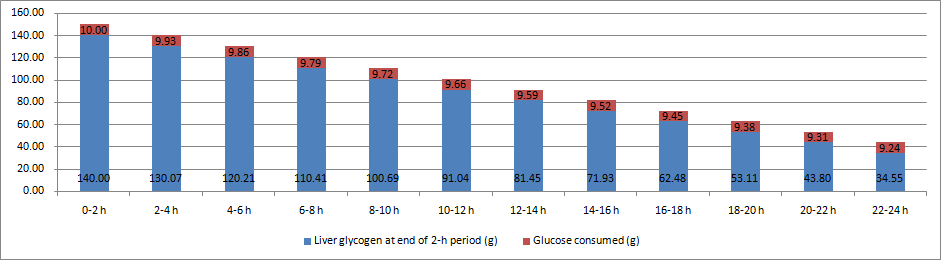

As you can see, after a 24-hour fast, John had about 35 g of glycogen left, which is enough for a few extra hours of fasting. At the 24-hour mark the body had no need to be using muscle protein to generate glucose. Maybe some of that happened, but probably not much if John was relaxed during the fast. (If he was stressed out, stress hormones would have increased blood glucose release significantly.) From the body’s perspective, muscle is “expensive”, whereas body fat is “cheap”. And body fat, converted to free fatty acids, is what is used to produce ketones during a fast.

Blood ketone concentration does not go up dramatically during a 24-hour fast, but it does after a 48-hour fast, when it becomes about 10 times higher. This major increase occurs primarily to spare muscle, including heart muscle. If the increase is much smaller during a 24-hour fast, one can reasonably assume that the body is not going to be using muscle during the fast. It can still rely on liver glycogen, together with a relatively small amount of ketones.

Then John did his strength training, after the 24-hour fast. When he did that, the muscles he used in the exercise session converted locally stored glycogen into lactate. A flood of lactate was secreted into the bloodstream, which was used by his liver to produce glucose and also to replenish liver glycogen a bit. Again, at this stage there was no need for John’s body to use muscle protein to generate glucose.

Counterintuitive as this may sound, the more different muscles John used, the more lactate was made available. If John did 20 sets of isolated bicep curls, for example, his body would not have released enough lactate to meet its glucose needs or replenish liver glycogen. As a result, stress hormones would go up a lot, and his body would send him some alarm signals. One of those signals is a feeling of “pins and needles”, which is sometimes confused with the symptoms of a heart attack.

John worked out various muscle groups for 30 minutes or so, and he did not even feel fatigued. He felt energetic, in part because his blood glucose went up a lot, peaking at 150 mg/dl, to meet muscle needs. This elevated blood glucose was caused by his liver producing blood glucose based on lactate and releasing it into his blood. Muscle glycogen was depleted as a result of that.

Do you lose any muscle if you lift weights after a 24-hour fast?

I don’t think so, if you deplete your glycogen stores by doing strength training on a regular basis, and also replenish them on a regular basis. In fact, your liver glycogen tank will increase in size, and you may find yourself being able to fast for many hours without feeling hungry.

You will feel hungry after the strength training session following the fast though; probably ravenous.

References

Brooks, G.A., Fahey, T.D., & Baldwin, K.M. (2005). Exercise physiology: Human bioenergetics and its applications. Boston, MA: McGraw-Hill.

Wilmore, J.H., Costill, D.L., & Kenney, W.L. (2007). Physiology of sport and exercise. Champaign, IL: Human Kinetics.

Monday, November 1, 2010

Amino acids in skeletal muscle: Are protein supplements as good as advertised?

When protein-rich foods, like meat, are ingested they are first broken down into peptides through digestion. As digestion continues, peptides are broken down into amino acids, which then enter circulation, becoming part of the blood plasma. They are then either incorporated into various tissues, such as skeletal muscle, or used for other purposes (e.g., oxidation and glucose generation). The table below shows the amino acid composition of blood plasma and skeletal muscle. It was taken from Brooks et al. (2005), and published originally in a classic 1974 article by Bergström and colleagues. Essential amino acids, shown at the bottom of the table, are those that have to be consumed through the diet. The human body cannot synthesize them. (Tyrosine is essential in children; in adults tryptophan is essential.)


The data is from 18 young and healthy individuals (16 males and 2 females) after an overnight fast. The gradient is a measure that contrasts the concentration of an amino acid in muscle against its concentration in blood plasma. Amino acids are transported into muscle cells by amino acid transporters, such as the vesicular glutamate transporter 1 (VGLUT1). Transporters exist because without them a substance’s gradient higher or lower than 1 would induce diffusion through cell membranes; that is, without transporters anything would enter or leave cells.

Research suggests that muscle uptake of amino acids is positively correlated with the concentration of the amino acids in plasma (as well as the level of activity of transporters) and that this effect is negatively moderated by the gradient. This is especially true after strength training, when protein synthesis is greatly enhanced. In other words, if the plasma concentration of an amino acid such as alanine is high, muscle uptake will be increased (with the proper stimulus; e.g., strength training). But if a lot of alanine is already present in muscle cells when compared to plasma (which is normally the case, since alanine’s 7.3 gradient is relatively high), more plasma alanine will be needed to increase muscle uptake.

The amino acid makeup of skeletal muscle is a product of evolutionary forces, which largely operated on our Paleolithic ancestors. Those ancestors obtained their protein primarily from meat, eggs, vegetables, fruits, and nuts. Vegetables and fruits today are generally poor sources of protein; that was probably the case in the Paleolithic as well. Also, only when very young our Paleolithic ancestors obtained their protein from human milk. It is very unlikely that they drank the milk of other animals. Still, many people today possess genetic adaptations that enable them to consume milk (and dairy products in general) effectively due to a more recent (Neolithic) ancestral heritage. A food-related trait can evolve very fast – e.g., in a few hundred years.

One implication of all of this is that protein supplements in general may not be better sources of amino acids than natural protein-rich foods, such as meat or eggs. Supplements may provide more of certain amino acids than others sources, but given the amino acid makeup of skeletal muscle, a supplemental overload of a particular amino acid is unlikely to be particularly healthy. That overload may induce an unnatural increase in amino acid oxidation, or an abnormal generation of glucose through gluconeogenesis. Depending on one’s overall diet, those may in turn lead to elevated blood glucose levels and/or a caloric surplus. The final outcome may be body fat gain.

Another implication is that man-made foods that claim to be high in protein, and that are thus advertised as muscle growth supplements, may actually be poor sources of those amino acids whose concentration in muscle are highest. (You need to check the label for the amino acid composition, and trust the manufacturer.) Moreover, if they are sources of nonessential amino acids, they may overload your body if you consume a balanced diet. Interestingly, nonessential amino acids are synthesized from carbon sources. A good source of carbon is glucose.

Among the essential amino acids are a group called branched-chain amino acids (BCAA) – leucine, isoleucine, and valine. Much is made of these amino acids, but their concentration in muscle in adults is not that high. That is, they do not contribute significantly as building blocks to protein synthesis in skeletal muscle. What makes BCAAs somewhat unique is that they are highly ketogenic, and somewhat glucogenic (via gluconeogenesis). They also lead to insulin spikes. Ingestion of BCAAs increases the blood concentration of two of the three human ketone bodies (acetone and acetoacetate). Ketosis is both protein and glycogen sparing (but gluconeogenesis is not), which is among the reasons why ketosis is significantly induced by exercise (blood ketones concentration is much more elevated after exercise than after a 20 h fast). This is probably why some exercise physiologists and personal trainers recommend consumption of BCAAs immediately prior to or during anaerobic exercise.

Why do carnivores often consume prey animals whole? (Consumption of eggs is not the same, but similar, because an egg is the starting point for the development of a whole animal.) Carnivores consume prey animals whole arguably because prey animals have those tissues (muscle, organ etc. tissues) that carnivores also have, in roughly the same amounts. Prey animals that are herbivores do all the work of converting their own prey (plants) to tissues that they share with carnivores. Carnivores benefit from that work, paying back herbivores by placing selective pressures on them that are health-promoting at the population level. (Carnivores usually target those prey animals that show signs of weakness or disease.)

Supplements would be truly natural if they provided nutrients that mimicked eating an animal whole. Most supplements do not get even close to doing that; and this includes protein supplements.

Reference

Brooks, G.A., Fahey, T.D., & Baldwin, K.M. (2005). Exercise physiology: Human bioenergetics and its applications. Boston, MA: McGraw-Hill.

Sunday, April 18, 2010

Ketones and Ketosis: Physiological and pathological forms

Ketones are compounds that have a specific chemical structure. The figure below (from: Wikipedia) shows the chemical structure of various types of ketones. As you can see, all ketones share a carbonyl group; that is the “O=” part of their chemical structure. A carbonyl group is an oxygen atom double-bonded to a carbon atom.


Technically speaking, many substances can be classified as ketones. Not all of these are involved in the same metabolic processes in humans. For example, fructose is technically a ketone, but it is not one of the three main ketones produced by humans from dietary macronutrients (discussed below), and is not metabolized in the same way as are those three main ketones.

Humans, as well as most other vertebrates, produce three main ketones (also known as ketone bodies) from dietary macronutrients. These are acetone, acetoacetate and beta-hydroxybutyrate. Low carbohydrate diets tend to promote glycogen depletion, which in turn leads to increased production of these ketones. Glycogen is stored in the liver and muscles. Liver glycogen is used by the body to maintain blood glucose levels within a narrow range in the fasted state. Examples of diets that tend to promote glycogen depletion are the Atkins Diet and Kwaśniewski’s Optimal Diet.

A search for articles on ketosis in scientific databases usually returns a large number of articles dealing with ketosis in cows. Why? The reason is that ketosis reduces milk production, by both reducing the amount of fat and glucose available for milk synthesis. In fact, ketosis is referred to as a “disease” in cows.

In humans, most articles on ketosis refer to pathological ketosis (a.k.a. ketoacidosis), especially in the context of uncontrolled diabetes. One notable exception is an article by Williamson (2005), from which the table below was taken. The table shows ketone concentrations in the blood under various circumstances, in mmol/l.


As you can see, relatively high concentrations of ketones occur in newborn babies (neonate), in adults post-exercise, and in adults fed a high fat diet. Generally speaking, a high fat diet is a low carbohydrate diet, and a high carbohydrate diet is a low fat diet. (One occasionally sees diets that are high in both carbohydrates and fat; which seem excellent at increasing body fat and thus reducing life span. This diet is apparently popular among sumo wrestlers, where genetics and vigorous exercise usually counter the negative diet effects.)

Situations in which ketosis occurs in newborn babies (neonate), in adults post-exercise, and in adults fed a high fat diet are all examples of physiological, or benign, ketosis. Ketones are also found in low concentrations in adults fed a standard American diet.

Ketones are found in very high concentrations in adults with untreated diabetes. This is an example of pathological ketosis, even though ketones are produced as part of a protective compensatory mechanism to spare glucose for the brain and red blood cells (which need glucose to function properly). Pathological ketosis leads to serum ketone levels that can be as much as 80 times (or more) those found in physiological ketosis.

Serum ketone concentrations increase proportionally to decreases in stored glycogen and, when glycogen is low or absent, correlate strongly (and inversely) with blood glucose levels. In some individuals glycogen is practically absent due to a genetic condition that leads to hepatic glycogen synthase deficiency. This is a deficiency of the enzyme that promotes glycogen synthesis by the liver. The figure below (also from Williamson, 2005) shows the variations in glucose and ketone levels in a child with glycogen synthase deficiency.


What happened with this child? Williamson answers this question: “It is of interest that this particular child suffered no ill effects from the daily exposure to high concentrations of ketone bodies, underlining their role as normal substrates for the brain when available.”

Unlike glucose and lipoprotein-bound fats (in VLDL, for example), unused ketones cannot be converted back to substances that can be stored by the body. Thus excess ketones are eliminated in the urine; leading to their detection by various tests, e.g., Ketostix tests. This elimination of unused ketones in the urine is one of the reasons why low carbohydrate diets are believed to lead to enhanced body fat loss.

In summary, ketones are present in the blood most of the time, in most people, whether they are on a ketogenic diet or not. If they do not show up in the urine, it does not mean that they are not present in the blood; although it usually means that their concentration in the blood is not that high. Like glucose, ketones are soluble in water, and thus circulate in the blood without the need for carriers (e.g., albumin, which is needed for the transport of free fatty acids; and VLDL, needed for the transport of triglycerides). Like glucose, they are used as sources of energy by the brain and by muscle tissues.

It has been speculated that ketosis leads to accelerated aging, through the formation of advanced glycation endproducts (AGEs), a speculation that seems to be largely unfounded (see this post). It is difficult to believe that a metabolic process that is universally found in babies and adults post-exercise would have been favored by evolution if it led to accelerated aging.

References:

Williamson, D.H. (2005). Ketosis. Encyclopedia of Human Nutrition, 91-98.

Thursday, March 11, 2010

Ketosis, methylglyoxal, and accelerated aging: Fact or fiction?

Ketosis is a state typically associated with very low carbohydrate diets, such as the Atkins diet. In this state, the liver produces ketones based on fat (body fat or dietary fat). Unlike fats, ketones are water soluble and used by many tissues (including brain tissues) as a source of energy.

Unlike glucose and lipoprotein-bound fats (in VLDL, for example), unused ketones cannot be converted back to substances that can be stored by the body. Thus excess ketones are eliminated in the urine; leading to their detection by various tests, e.g., Ketostix tests.

This elimination of unused ketones in the urine is one of the reasons why very low carbohydrate diets are believed to lead to enhanced body fat loss.

From an evolutionary perspective, one could argue that a ketosis state that involves the elimination of ketones in the urine is an inefficient and unnatural emergency mechanism. For our Paleolithic ancestors, dying of starvation was a much bigger problem than dying of obesity complications.

An interesting hypothesis has been around for quite some time about a possible negative effect of ketosis. It goes more or less like this. Ketosis leads to the production of an organic compound called methylglyoxal, which is believed to be a powerful agent of glycation (a misnomer; see note below).

Glycation is a process whereby sugar molecules “stick” to protein or fat molecules, impairing their function. Glycation leads to the formation of advanced glycation endproducts (AGEs), which appear to be associated with a host of diseases, including diabetes, and to be implicated in accelerated aging (or “ageing”, with British spelling).

In short: ketosis leads to the production of methylglyoxal, which leads to the formation of AGEs, which in turn cause diseases and accelerated aging.

Note: Since glycation refers to “sugar” molecules sticking to protein and fats, its use in the context of methylglyoxal is arguably incorrect. Methylglyoxal is not a sugar, but an aldehyde.

One of the strongest indictments of ketosis, in relation to methylglyoxal, is made in a fairly well referenced book by De Grey (2007); the full reference to the book is at the end of this post. De Grey’s book is about aging, and how to stop or at least delay it. Overall, it is an excellent book. Here is some relevant text, from page 173 of the book:
… one established effect of very low-carbohydrate diets of the Atkins type is to bring down both triglyceride levels and the body’s total exposure to carbohydrates, so some advocates have hypothesized that these diets world reduce a person’s AGE burden. Unfortunately, it turns out that the metabolic state that these diets induce (the notorious “ketosis”) has the unfortunate side effect of causing a jump in the production of the oxoaldehyde methylglyoxal, a major precursor of AGEs that is also, ironically, produced within cells of diabetic patients when they are forced to take in more glucose than they can immediately process … methylglyoxal is far more chemically reactive than blood sugar (up to 40,000 times more reactive, in fact), and is known to cause wide-ranging damage in the body, of which AGE cross-links are but one example. This potentially makes the Atkins diet a recipe for accelerated AGEing …
Is this notion that ketosis, through methylglyoxal, can cause accelerated aging fact or fiction?

Sorry, but I need to consult with my guru before I post my answer.

Reference:

De Grey, A. (2007). Ending aging: The rejuvenation breakthroughs that could reverse human aging in our lifetime. New York: NY: St. Martin’s Press.