A joke among software developers is that the computer does exactly what you tell it to do, but not necessarily what you want it to do. Similarly, through CA your body responds exactly to the inputs you give it, but not necessarily in the way you would like it to respond. For example, a moderate caloric deficit may lead to slow body fat loss, while a very high caloric deficit may bring body fat loss to a halt.
Strength training seems to lead to various adaptations, which can be understood through the lens provided by CA. One of them is a dramatic increase in the ability of the body to store glycogen, in both liver and muscle. Glycogen is the main fuel used by muscle during anaerobic exercise. Regular strength training causes, over time, glycogen stores to more than double. And about 2.6 the amount of glycogen is also stored as water.
When one looks bigger and becomes stronger as a result of strength training, that is in no small part due to increases in glycogen and water stored. More glycogen stored in muscle leads to more strength, which is essentially a measure of one’s ability to move a certain amount of weight around. More muscle protein is also associated with more strength.
Thinking in terms of CA, the increase in the body’s ability to store glycogen is to be expected, as long as glycogen stores are depleted and replenished on a regular basis. By doing strength training regularly, you are telling your body that you need a lot of glycogen on a regular basis, and the body responds. But if you do not replenish your glycogen stores on a regular basis, you are also sending your body a conflicting message, which is that dietary sources of the substances used to make glycogen are not readily available. Among the substances that are used to make glycogen, the best seems to be the combination of fructose and glucose that one finds in fruits.
Let us assume a 160-lbs untrained person, John, who stored about 100 g of glycogen in his liver, and about 500 g in his muscle cells, before starting a strength training program. Let us assume, conservatively, that after 6 months of training he increased the size of his liver glycogen tank to 150 g. Muscle glycogen storage was also increased, but that is less relevant for the discussion in this post.
Then John fasted for 24 hours before a strength training session, just to see what would happen. While fasting he went about his business, doing light activities, which led to a caloric expenditure of about 100 calories per hour (equivalent to 2400 per day). About 20 percent of that, or 20 calories per hour, came from a combination of blood glucose and ketones. Contrary to popular belief, ketones can always be found in circulation. If only glucose were used, 5 g of glucose per hour would be needed to supply those 20 calories.
During the fast, John’s glucose needs, driven primarily by his brain’s needs, were met by conversion of liver glycogen to blood glucose. His muscle glycogen was pretty much “locked” during the fast; because he was doing only light activities, which rely primarily on fat as fuel. Muscle glycogen is “unlocked” through anaerobic exercise, of which strength training is an instance.
One of the roles of ketones is to spare liver glycogen, delaying the use of muscle protein to make glucose down the road, so the percentage of ketones in circulation in John’s body increased in a way that was inversely proportional to stored liver glycogen. According to this study, after 72 hours fasting about 25 percent of the body’s glucose needs are met by ketones. (This may be an underestimation.)
If we assume a linear increase in ketone concentration, this leads to a 0.69 percent increase in circulating ketones for every 2-hour period. (This is a simplification, as the increase is very likely nonlinear.) So, when we look at John’s liver glycogen tank, it probably went down in a way similar to that depicted on the figure below. The blue bars show liver glycogen at the end of each 2-hour period. The red bars show the approximate amount of glucose consumed during each 2-hour period. Glucose consumed goes down as liver glycogen decreases, because of the increase in blood ketones.
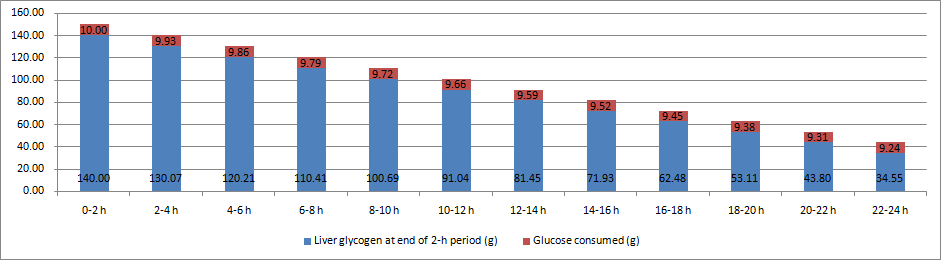
As you can see, after a 24-hour fast, John had about 35 g of glycogen left, which is enough for a few extra hours of fasting. At the 24-hour mark the body had no need to be using muscle protein to generate glucose. Maybe some of that happened, but probably not much if John was relaxed during the fast. (If he was stressed out, stress hormones would have increased blood glucose release significantly.) From the body’s perspective, muscle is “expensive”, whereas body fat is “cheap”. And body fat, converted to free fatty acids, is what is used to produce ketones during a fast.
Blood ketone concentration does not go up dramatically during a 24-hour fast, but it does after a 48-hour fast, when it becomes about 10 times higher. This major increase occurs primarily to spare muscle, including heart muscle. If the increase is much smaller during a 24-hour fast, one can reasonably assume that the body is not going to be using muscle during the fast. It can still rely on liver glycogen, together with a relatively small amount of ketones.
Then John did his strength training, after the 24-hour fast. When he did that, the muscles he used in the exercise session converted locally stored glycogen into lactate. A flood of lactate was secreted into the bloodstream, which was used by his liver to produce glucose and also to replenish liver glycogen a bit. Again, at this stage there was no need for John’s body to use muscle protein to generate glucose.
Counterintuitive as this may sound, the more different muscles John used, the more lactate was made available. If John did 20 sets of isolated bicep curls, for example, his body would not have released enough lactate to meet its glucose needs or replenish liver glycogen. As a result, stress hormones would go up a lot, and his body would send him some alarm signals. One of those signals is a feeling of “pins and needles”, which is sometimes confused with the symptoms of a heart attack.
John worked out various muscle groups for 30 minutes or so, and he did not even feel fatigued. He felt energetic, in part because his blood glucose went up a lot, peaking at 150 mg/dl, to meet muscle needs. This elevated blood glucose was caused by his liver producing blood glucose based on lactate and releasing it into his blood. Muscle glycogen was depleted as a result of that.
Do you lose any muscle if you lift weights after a 24-hour fast?
I don’t think so, if you deplete your glycogen stores by doing strength training on a regular basis, and also replenish them on a regular basis. In fact, your liver glycogen tank will increase in size, and you may find yourself being able to fast for many hours without feeling hungry.
You will feel hungry after the strength training session following the fast though; probably ravenous.
References
Brooks, G.A., Fahey, T.D., & Baldwin, K.M. (2005). Exercise physiology: Human bioenergetics and its applications. Boston, MA: McGraw-Hill.
Wilmore, J.H., Costill, D.L., & Kenney, W.L. (2007). Physiology of sport and exercise. Champaign, IL: Human Kinetics.


