Researchers can build mathematical equations (sometimes referred to as structural equations) that predict health outcomes based on health factors. Those mathematical equations can then be used in online calculators.
This link takes you to a government-sponsored calculator based on the Framingham Heart Study. It estimates 10-year risk for “hard” coronary heart disease outcomes (myocardial infarction and coronary death).
As you will notice, the link above does not take family history of disease into consideration. A different risk calculator, linked here, estimates a risk score called the Reynold Risk Score. It takes hsCRP (high sensitivity C-reactive protein, an inflammation marker) and family history in addition to the Framingham parameters in its risk score calculation.
Neither calculator asks for LDL cholesterol levels. I wonder why.
Friday, March 19, 2010
Wednesday, March 17, 2010
Book Review: The Primal Blueprint
Mark Sisson has been a central figure in the evolutionary health community since he began his weblog Mark's Daily Apple in 2006. He and his staff have been posting daily on his blog ever since. He has also written several other books, edited the Optimum Health newsletter, competed as a high-level endurance athlete, and served on the International Triathlon Union as the anti-doping chairman, all of which you can read about on his biography page. Mark is a practice-what-you-preach kind of guy, and if physical appearance means anything, he's on to something.
In 2009, Mark published his long-awaited book The Primal Blueprint. He self-published the book, which has advantages and disadvantages. The big advantage is that you aren't subject to the sometimes onerous demands of publishers, who attempt to maximize sales at Barnes and Noble. The front cover sports a simple picture of Mark, rather than a sunbaked swimsuit model, and the back cover offers no ridiculous claims of instant beauty and fat loss.
The drawback of self-publishing is it's more difficult to break into a wider market. That's why Mark has asked me to publish my review of his book today. He's trying to push it up in the Amazon.com rankings so that it gets a broader exposure. If you've been thinking about buying Mark's book, now is a good time to do it. If you order it from Amazon.com on March 17th, Mark is offering to sweeten the deal with some freebies on his site Mark's Daily Apple. Full disclosure: I'm not getting anything out of this, I'm simply mentioning it because I was reviewing Mark's book anyway and I thought some readers might enjoy it.
The Primal Blueprint is not a weight loss or diet book, it's a lifestyle program with an evolutionary slant. Mark uses the example of historical and contemporary hunter-gatherers as a model, and attempts to apply those lessons to life in the 21st century. He does it in a way that's empowering accessible to nearly everyone. To illustrate his points, he uses the example of an archetypal hunter-gatherer called Grok, and his 21st century mirror image, the Korg family.
The diet section will be familiar to anyone who has read about "paleolithic"-type diets. He advocates eating meats including organs, seafood, eggs, nuts, abundant vegetables, and fruit. He also suggests avoiding grains, legumes, dairy (although he's not very militant about this one), processed food in general, and reducing carbohydrate to less than 150 grams per day. I like his diet suggestions because they focus on real food. Mark is not a drill sergeant. He tries to create a plan that will be sustainable in the long run, by staying positive and allowing for cheats.
We part ways on the issue of carbohydrate. He suggests that eating more than 150 grams of carbohydrate per day leads to fat gain and disease, whereas I feel that position is untenable in light of what we know of non-industrial cultures (including some relatively high-carbohydrate hunter-gatherers). Although carbohydrate restriction (or at least wheat and sugar restriction) does have its place in treating obesity and metabolic dysfunction in modern populations, ultimately I don't think it's necessary for the prevention of those same problems, and it can even be counterproductive in some cases. Mark does acknowledge that refined carbohydrates are the main culprits.
The book's diet section also recommends nutritional supplements, including a multivitamin/mineral, antioxidant supplement, probiotics, protein powder and fish oil. I'm not a big proponent of supplementation. I'm also a bit of a hypocrite because I do take small doses of fish oil (when I haven't had seafood recently), and vitamin D in wintertime. But I can't get behind protein powders and antioxidant supplements.
Mark's suggestions for exercise, sun exposure, sleep and stress management make good sense to me. In a nutshell: do all three, but keep the exercise varied and don't overdo it. As a former high-level endurance athlete, he has a lot of credibility here. He puts everything in a format that's practical, accessible and empowering.
I think The Primal Blueprint is a useful book for a person who wants to maintain or improve her health. Although we disagree on the issue of carbohydrate, the diet and lifestyle advice is solid and will definitely be a vast improvement over what the average person is doing. The Primal Blueprint is not an academic book, nor does it attempt to be. It doesn't contain many references (although it does contain some), and it won't satisfy someone looking for an in-depth discussion of the scientific literature. However, it's perfect for someone who's getting started and needs guidance, or who simply wants a more comprehensive source than reading blog snippets. It would make a great gift for that family member or friend who's been asking how you stay in such good shape.

Thursday, March 11, 2010
Ketosis, methylglyoxal, and accelerated aging: Fact or fiction?
Ketosis is a state typically associated with very low carbohydrate diets, such as the Atkins diet. In this state, the liver produces ketones based on fat (body fat or dietary fat). Unlike fats, ketones are water soluble and used by many tissues (including brain tissues) as a source of energy.
Unlike glucose and lipoprotein-bound fats (in VLDL, for example), unused ketones cannot be converted back to substances that can be stored by the body. Thus excess ketones are eliminated in the urine; leading to their detection by various tests, e.g., Ketostix tests.
This elimination of unused ketones in the urine is one of the reasons why very low carbohydrate diets are believed to lead to enhanced body fat loss.
From an evolutionary perspective, one could argue that a ketosis state that involves the elimination of ketones in the urine is an inefficient and unnatural emergency mechanism. For our Paleolithic ancestors, dying of starvation was a much bigger problem than dying of obesity complications.
An interesting hypothesis has been around for quite some time about a possible negative effect of ketosis. It goes more or less like this. Ketosis leads to the production of an organic compound called methylglyoxal, which is believed to be a powerful agent of glycation (a misnomer; see note below).
Glycation is a process whereby sugar molecules “stick” to protein or fat molecules, impairing their function. Glycation leads to the formation of advanced glycation endproducts (AGEs), which appear to be associated with a host of diseases, including diabetes, and to be implicated in accelerated aging (or “ageing”, with British spelling).
In short: ketosis leads to the production of methylglyoxal, which leads to the formation of AGEs, which in turn cause diseases and accelerated aging.
Note: Since glycation refers to “sugar” molecules sticking to protein and fats, its use in the context of methylglyoxal is arguably incorrect. Methylglyoxal is not a sugar, but an aldehyde.
One of the strongest indictments of ketosis, in relation to methylglyoxal, is made in a fairly well referenced book by De Grey (2007); the full reference to the book is at the end of this post. De Grey’s book is about aging, and how to stop or at least delay it. Overall, it is an excellent book. Here is some relevant text, from page 173 of the book:
Sorry, but I need to consult with my guru before I post my answer.
Reference:
De Grey, A. (2007). Ending aging: The rejuvenation breakthroughs that could reverse human aging in our lifetime. New York: NY: St. Martin’s Press.
Unlike glucose and lipoprotein-bound fats (in VLDL, for example), unused ketones cannot be converted back to substances that can be stored by the body. Thus excess ketones are eliminated in the urine; leading to their detection by various tests, e.g., Ketostix tests.
This elimination of unused ketones in the urine is one of the reasons why very low carbohydrate diets are believed to lead to enhanced body fat loss.
From an evolutionary perspective, one could argue that a ketosis state that involves the elimination of ketones in the urine is an inefficient and unnatural emergency mechanism. For our Paleolithic ancestors, dying of starvation was a much bigger problem than dying of obesity complications.
An interesting hypothesis has been around for quite some time about a possible negative effect of ketosis. It goes more or less like this. Ketosis leads to the production of an organic compound called methylglyoxal, which is believed to be a powerful agent of glycation (a misnomer; see note below).
Glycation is a process whereby sugar molecules “stick” to protein or fat molecules, impairing their function. Glycation leads to the formation of advanced glycation endproducts (AGEs), which appear to be associated with a host of diseases, including diabetes, and to be implicated in accelerated aging (or “ageing”, with British spelling).
In short: ketosis leads to the production of methylglyoxal, which leads to the formation of AGEs, which in turn cause diseases and accelerated aging.
Note: Since glycation refers to “sugar” molecules sticking to protein and fats, its use in the context of methylglyoxal is arguably incorrect. Methylglyoxal is not a sugar, but an aldehyde.
One of the strongest indictments of ketosis, in relation to methylglyoxal, is made in a fairly well referenced book by De Grey (2007); the full reference to the book is at the end of this post. De Grey’s book is about aging, and how to stop or at least delay it. Overall, it is an excellent book. Here is some relevant text, from page 173 of the book:
… one established effect of very low-carbohydrate diets of the Atkins type is to bring down both triglyceride levels and the body’s total exposure to carbohydrates, so some advocates have hypothesized that these diets world reduce a person’s AGE burden. Unfortunately, it turns out that the metabolic state that these diets induce (the notorious “ketosis”) has the unfortunate side effect of causing a jump in the production of the oxoaldehyde methylglyoxal, a major precursor of AGEs that is also, ironically, produced within cells of diabetic patients when they are forced to take in more glucose than they can immediately process … methylglyoxal is far more chemically reactive than blood sugar (up to 40,000 times more reactive, in fact), and is known to cause wide-ranging damage in the body, of which AGE cross-links are but one example. This potentially makes the Atkins diet a recipe for accelerated AGEing …Is this notion that ketosis, through methylglyoxal, can cause accelerated aging fact or fiction?
Sorry, but I need to consult with my guru before I post my answer.
Reference:
De Grey, A. (2007). Ending aging: The rejuvenation breakthroughs that could reverse human aging in our lifetime. New York: NY: St. Martin’s Press.
Vitamin D May Prevent Flu and Asthma
The AJCN just published a new controlled trial evaluating the effectiveness of vitamin D supplements on flu and asthma (1). Dr. Hiroyuki Ida's group gave Japanese schoolchildren (10 years average age) 1,200 IU of vitamin D3 or placebo per day from December through March. They found that children taking vitamin D had a significantly lower incidence of influenza A but not influenza B. These are two strains of flu that each accounted for roughly half the flu incidence in this population. Sadly, if you add the total flu incidence for A and B together (which the authors don't do in their tables), vitamin D supplementation didn't reduce total flu incidence significantly.
They also found that in the subset of children not already taking vitamin D supplements, the effect was greater, with unsupplemented children contracting nearly three times as many influenza A infections as children receiving vitamin D. They didn't analyze the influenza B or total influenza incidence in that way, so we don't know if prior supplementation makes a difference there.
The most striking finding of the paper is that the vitamin D group suffered from 6 times fewer asthma attacks than the placebo group. This needs to be repeated but it's consistent with other data and I find it very encouraging.
The paper did have some limitations. They didn't measure vitamin D status so they have no way to know exactly how effective their pill-based supplements were.
Another problem is that they began collecting data immediately after beginning supplementation. Vitamin D is a fat-soluble vitamin that can take 3 months to reach maximum concentration in the body following supplementation. By the time the children were reaching their maximum serum concentration of vitamin D, the trial was over. It would be nice to see the next trial begin supplementation in the fall and look at flu incidence in the winter.
This paper comes on the heels of another showing that vitamin D is necessary for the activation of an immune cell called the killer T cell (2). These are important for resistance to infections and cancer. Overall, these papers add to the accumulating evidence that vitamin D is important for the proper functioning of the human immune system. However, mice may not be the best model for use in studying vitamin D biology. From the first paper:
The evolution of different mechanisms for the regulation of PLC-γ1 activity in human and mouse T cells parallels the development of divergent VDR-dependent and VDR-independent antimicrobial pathways in human and mouse macrophages31, respectively, and may reflect the fact that mice are nocturnal animals with fur and humans are daytime creatures that synthesize vitamin D in the skin after exposure to ultraviolet light.In other words, mice don't use vitamin D in the same way as humans because they have a different evolutionary relationship to it.
Wednesday, March 10, 2010
A False Dichotomy
In the discussion section of the last post, the eternal argument about non-industrial people arose: were their lives (a) "nasty, brutish and short" (Hobbes), or were they (b) "noble savages" (Shaftesbury) living in Eden? The former argument states that they had awful lives, and we should be glad we're living int he 21st century. The latter argument implies that we should emulate them as much as possible. Each side is bursting with anecdotes to support their position.
Any time the discussion reaches this point, it stops providing us anything useful. The argument is a false dichotomy, one in which neither answer is correct. The correct answer is (c): none of the above. Some aspects of hunter-gatherer life are preferable to ours, and some aspects of our lives are preferable to theirs. Understanding that we spent a lot of evolutionary time as hunter-gatherers, as well as a few thousand years in small, tightly knit agricultural communities, may be useful in understanding how to work constructively with our own bodies and minds in the modern world.
So please, let's leave behind the false dichotomy and foster a more nuanced understanding of the lives our ancestors led.
Monday, March 8, 2010
The Paleolithic Mind
I went to a meditation retreat this week with the Red Cedar Zen community in Bellingham. It was a good experience. Staring at a wall from 6 am to 9 pm for a few days gives you the opportunity to learn a few things about your mind. Some of these are things you already know on some level, but you just need to have them reinforced. For example, the weight of psychological stress that we carry in modern societies like the US. It's only when it goes away for a while that you can see how heavy it was.
I'm totally ignorant of the scientific literature on this, but the way I see it, there are at least two main sources of psychological stress in the modern world for which we aren't well equipped as human beings:
The author says this about their possessions:
Unfortunately, we have more than just possessions on our minds. To live in the modern world is to be pricked to death by a thousand small responsibilities. Remember to make your lunch. Remember to make a doctor's appointment, shop for groceries, tie your shoes, get your oil changed, send that e-mail, make dinner, go for a jog, vacuum the floor, take a shower, pick up the kids-- the list is endless. Are our memories as defective as we think they are, or are we simply not designed to keep track of so many details?
In hunter-gatherer times, we had stress. Homicide, accidents, infectious disease and predation were always stalking us. But did we have a constant flow of obligations clogging the paths of our minds?
Those times are gone for us, but perhaps keeping them in mind can help us live more constructively in the modern world. I find that meditation helps keep the thousand pricks of modern life in perspective, perhaps bringing my mind closer to the paleolithic state.
I'm totally ignorant of the scientific literature on this, but the way I see it, there are at least two main sources of psychological stress in the modern world for which we aren't well equipped as human beings:
- Being eternally and inescapably subordinate in a large social structure
- Having too many responsibilities such as possessions and obligations
The Hadza do not engage in warfare [although they do have homicide]. They've never lived densely enough to be seriously threatened by an infectious outbreak. They have no known history of famine; rather, there is evidence of people from a farming group coming to live with them during a time of crop failure. The Hadza diet remains even today more stable and varied than that of most of the world's citizens. They enjoy an extraordinary amount of leisure time. Anthropologists have estimated that they "work"—actively pursue food—four to six hours a day. And over all these thousands of years, they've left hardly more than a footprint on the land.This isn't intended to idealize their lifestyle, but to point out that being a hunter-gatherer has its advantages. One of these is a minimal social structure in which each person is has full authority over himself:
The Hadza recognize no official leaders. Camps are traditionally named after a senior male (hence, Onwas's camp), but this honor does not confer any particular power. Individual autonomy is the hallmark of the Hadza. No Hadza adult has authority over any other. None has more wealth; or, rather, they all have no wealth. There are few social obligations—no birthdays, no religious holidays, no anniversaries.Even "marriage" doesn't carry much obligation. The author describes the Hadza as "serial monogamists". The idea of an eternal bond between two individuals doesn't exist. Women are not subordinate to men:
Gender roles are distinct, but for women there is none of the forced subservience knit into many other cultures. A significant number of Hadza women who marry out of the group soon return, unwilling to accept bullying treatment. Among the Hadza, women are frequently the ones who initiate a breakup—woe to the man who proves himself an incompetent hunter or treats his wife poorly. In Onwas's camp, some of the loudest, brashest members were women.Contrast this with modern civilizations in which everyone has a boss-- whether it's at a job, in a marriage or under your country's legal system. I think this feeling of perpetual subordination is destructive to an animal such as ourselves, that has spent so much of its existence mostly free of these pressures.
The author says this about their possessions:
Traditional Hadza, like Onwas and his camp mates, live almost entirely free of possessions. The things they own—a cooking pot, a water container, an ax—can be wrapped in a blanket and carried over a shoulder.This resembles other African hunter-gatherer groups that have few and simple tools. From the book The !Kung San: Men, Women and Work in a Foraging Society:
!Kung tools are few in number, lightweight, made from locally available materials, and multipurpose.Again, this is in sharp contrast to the modern world, where we have so many belongings it's impossible to keep track of them all. We have giant houses that we "need" to store all these things, and still it doesn't seem like enough. Many of our possessions are indispensable if we want to fit in to society. We need (or feel we need) clothes, cookware, identification, money, transportation, furniture, tools, sports gear, et cetera. Having to be responsible for this extraordinary quantity of possessions (by evolutionary standards) is a heavy weight on our minds.
Unfortunately, we have more than just possessions on our minds. To live in the modern world is to be pricked to death by a thousand small responsibilities. Remember to make your lunch. Remember to make a doctor's appointment, shop for groceries, tie your shoes, get your oil changed, send that e-mail, make dinner, go for a jog, vacuum the floor, take a shower, pick up the kids-- the list is endless. Are our memories as defective as we think they are, or are we simply not designed to keep track of so many details?
In hunter-gatherer times, we had stress. Homicide, accidents, infectious disease and predation were always stalking us. But did we have a constant flow of obligations clogging the paths of our minds?
Those times are gone for us, but perhaps keeping them in mind can help us live more constructively in the modern world. I find that meditation helps keep the thousand pricks of modern life in perspective, perhaps bringing my mind closer to the paleolithic state.
Wednesday, March 3, 2010
Adiponectin and tumor necrosis factor-alpha levels after a high saturated fat meal
This is one of those interesting studies where the authors start with some pre-conceived assumptions and end up concluding something else, some way toward the opposite of what they assumed.
My final interpretation of the study results is a bit different though. It suggests that the results are actually the opposite of what the authors originally assumed.
The authors of the study (Poppitt et al., 2008; full reference at the end of this post) start by stating that since “… dietary fat is associated with increased lipid storage, weight gain, and obesity …” it is important to study the effect of dietary fat intake on the blood levels of certain substances that are associated with lipid disorders, weight gain and obesity.
In short, the authors start from the assumption that dietary fat is bad. By the way, this type of indictment of all fats is not very common these days. Usually saturated fat is the target.
Since dietary fat is assumed to be bad for us, that justifies the authors’ goal of studying the effect of dietary fat on certain hormones associated with bad health, including the body fat-secreted hormones adiponectin and tumor necrosis factor-alpha. Low levels of serum adiponectin, and elevated levels of tumor necrosis factor-alpha, are associated with various health complications.
In the study, a high-fat test meal with approximately 59 g of fat (71% of energy as fat) was given at breakfast on two occasions to 18 healthy and lean men. These men had, on average, 23 years of age, a 31-inch waist, and a body mass index of 22.9. In other words, they were young and fit.
Two fatty meal variations were used, one with a lot more saturated fat than the other. Their ratio of saturated:unsaturated fatty acids was 71:29 for the high saturated fat meal, and 55:45 for the other. The table below provides a more detailed picture of the fat composition of the meals. The authors refer to these meals as instances of “acute intake of dietary lipid”.

Lunch, snack and dinner meals were also served to the participants. Those meals were nearly fat-free, with 1 to 3 g of fat only; apparently to help the participants “recover” from the high fat meal. They included plenty of refined grains (e.g., pasta) and fruit juices. Way to go; give these folks refined carbohydrates and sugars galore to help them recover from the “damage” done by the high fat meal!
Blood samples were collected at 0 (baseline), 1, 3, and 6 h for the measurement of various substances, including the body fat hormones adiponectin and tumor necrosis factor-alpha levels.
The figure below shows the variation in adiponectin levels at several times after the meal. The black circles are for the high saturated fat group, and the white circles for the other group. Adiponectin levels do not really start at the same level for both groups, which makes the graph a bit unclear; to better interpret the graph it may be a good idea to simply ignore the first (white) circle at the zero mark on the vertical axis. Also, no hormone levels were negative, of course; the zero on the vertical axis represents a reference value.
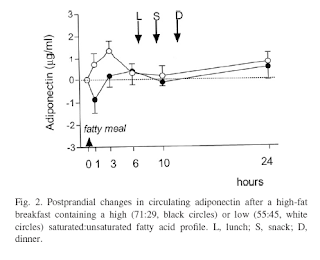
As we can see from the figure above, adiponectin levels go up for both groups after the fatty meal, and end up higher than they started for both groups; more for the high saturated fat than for the low saturated fat group. They are at very similar levels at the 24 h mark, but the levels at 24 h for the high saturated fat group appear to be a lot higher than they were right after the fatty meal. (The start point for the high saturated fat group being the first black circle from the left on the graph.) None of the differences are reported as significant. This is not surprising, given the small sample.
The figure below shows the variation in tumor necrosis factor-alpha levels at several times after the meal. This is an even more interesting one, because it suggests a possible negative effect of the low fat meals.
 In terms of tumor necrosis factor-alpha levels, the figure above suggests that both groups end up higher than they started, by about the same amount, which is not very good. (With tumor necrosis factor-alpha, unlike adiponectin, the less you have the better - so to speak, the hormone has important functions.) Again, none of the differences, with the exception of one, are reported as significant. The exception is the tumor necrosis factor-alpha level at 6 h for the low saturated fat group, which is significantly lower. But that difference disappears at the 10 h mark, never to be seen again.
Interestingly, note that tumor necrosis factor-alpha levels go up very clearly after the additional meals, which were low fat meals rich in refined carbohydrate and sugars. The variation in adiponectin is not as clearly associated with the additional meals. The points at which those meals were served are indicated by the arrows at the top of the graph; first arrow from left for lunch, second for a snack, and third arrow for dinner.
The conclusion by the authors of the study was that there is “… no evidence from this study of lean, healthy male subjects that the adipose hormone adiponectin is sensitive to acute intake of dietary lipid or to an increase in fatty acid saturation.” They do acknowledge the reduction in tumor necrosis factor-alpha up until the start of the low fat meals, and say that the “mechanism leading to the decrease in TNF-alpha on the high SFA:USFA treatment in our trial is unknown to us.”
My interpretation of this study is that, at least for young and lean men:
- There is some evidence that dietary saturated fat intake leads to increased levels of circulating adiponectin and decreased levels of tumor necrosis factor-alpha in the first few hours after a meal rich in saturated fat; with plenty of palmitic acid in it, by the way, of which animal fat is a great source. These are desirable and health-promoting hormonal responses.
- These is some evidence that meals high in refined carbohydrates and sugars increase levels of circulating tumor necrosis factor-alpha in the hours following the meals. Elevated levels of tumor necrosis factor-alpha are not good news; something that I guess is implied by the name of the hormone.
- There is some evidence that dietary saturated fat intake leads to an increase in adiponectin levels 24 h after a high fat meal, even when it is followed by low fat meals high in refined carbohydrates and sugars. This suggests a protective effect, which is in line with the hypothesis that adiponectin is not only a health marker by also a health-promoting hormone.
Due to the small sample used, none of the conclusions above is based on statistically significant results. More research is needed in the future, with larger samples. I am not sure it will happen though. This study’s findings were obviously accidental, and saturated fat phobia is still widespread.
Adiponectin is highly correlated with body weight, particularly weight associated with body fat mass. So, if you were able to achieve weight loss through a low carbohydrate diet involving a high consumption of saturated fat, there is absolutely no need to change that based on the results of this study.
Plus, saturated fat has the added benefit that it increases HDL cholesterol, the “good” cholesterol.
Reference:
Poppitt, S.D. et al. (2008). Postprandial response of adiponectin, interleukin-6, tumor necrosis factor-α, and C-reactive protein to a high-fat dietary load. Nutrition, 24(4), 322-329.
My final interpretation of the study results is a bit different though. It suggests that the results are actually the opposite of what the authors originally assumed.
The authors of the study (Poppitt et al., 2008; full reference at the end of this post) start by stating that since “… dietary fat is associated with increased lipid storage, weight gain, and obesity …” it is important to study the effect of dietary fat intake on the blood levels of certain substances that are associated with lipid disorders, weight gain and obesity.
In short, the authors start from the assumption that dietary fat is bad. By the way, this type of indictment of all fats is not very common these days. Usually saturated fat is the target.
Since dietary fat is assumed to be bad for us, that justifies the authors’ goal of studying the effect of dietary fat on certain hormones associated with bad health, including the body fat-secreted hormones adiponectin and tumor necrosis factor-alpha. Low levels of serum adiponectin, and elevated levels of tumor necrosis factor-alpha, are associated with various health complications.
In the study, a high-fat test meal with approximately 59 g of fat (71% of energy as fat) was given at breakfast on two occasions to 18 healthy and lean men. These men had, on average, 23 years of age, a 31-inch waist, and a body mass index of 22.9. In other words, they were young and fit.
Two fatty meal variations were used, one with a lot more saturated fat than the other. Their ratio of saturated:unsaturated fatty acids was 71:29 for the high saturated fat meal, and 55:45 for the other. The table below provides a more detailed picture of the fat composition of the meals. The authors refer to these meals as instances of “acute intake of dietary lipid”.

Lunch, snack and dinner meals were also served to the participants. Those meals were nearly fat-free, with 1 to 3 g of fat only; apparently to help the participants “recover” from the high fat meal. They included plenty of refined grains (e.g., pasta) and fruit juices. Way to go; give these folks refined carbohydrates and sugars galore to help them recover from the “damage” done by the high fat meal!
Blood samples were collected at 0 (baseline), 1, 3, and 6 h for the measurement of various substances, including the body fat hormones adiponectin and tumor necrosis factor-alpha levels.
The figure below shows the variation in adiponectin levels at several times after the meal. The black circles are for the high saturated fat group, and the white circles for the other group. Adiponectin levels do not really start at the same level for both groups, which makes the graph a bit unclear; to better interpret the graph it may be a good idea to simply ignore the first (white) circle at the zero mark on the vertical axis. Also, no hormone levels were negative, of course; the zero on the vertical axis represents a reference value.

As we can see from the figure above, adiponectin levels go up for both groups after the fatty meal, and end up higher than they started for both groups; more for the high saturated fat than for the low saturated fat group. They are at very similar levels at the 24 h mark, but the levels at 24 h for the high saturated fat group appear to be a lot higher than they were right after the fatty meal. (The start point for the high saturated fat group being the first black circle from the left on the graph.) None of the differences are reported as significant. This is not surprising, given the small sample.
The figure below shows the variation in tumor necrosis factor-alpha levels at several times after the meal. This is an even more interesting one, because it suggests a possible negative effect of the low fat meals.

Interestingly, note that tumor necrosis factor-alpha levels go up very clearly after the additional meals, which were low fat meals rich in refined carbohydrate and sugars. The variation in adiponectin is not as clearly associated with the additional meals. The points at which those meals were served are indicated by the arrows at the top of the graph; first arrow from left for lunch, second for a snack, and third arrow for dinner.
The conclusion by the authors of the study was that there is “… no evidence from this study of lean, healthy male subjects that the adipose hormone adiponectin is sensitive to acute intake of dietary lipid or to an increase in fatty acid saturation.” They do acknowledge the reduction in tumor necrosis factor-alpha up until the start of the low fat meals, and say that the “mechanism leading to the decrease in TNF-alpha on the high SFA:USFA treatment in our trial is unknown to us.”
My interpretation of this study is that, at least for young and lean men:
- There is some evidence that dietary saturated fat intake leads to increased levels of circulating adiponectin and decreased levels of tumor necrosis factor-alpha in the first few hours after a meal rich in saturated fat; with plenty of palmitic acid in it, by the way, of which animal fat is a great source. These are desirable and health-promoting hormonal responses.
- These is some evidence that meals high in refined carbohydrates and sugars increase levels of circulating tumor necrosis factor-alpha in the hours following the meals. Elevated levels of tumor necrosis factor-alpha are not good news; something that I guess is implied by the name of the hormone.
- There is some evidence that dietary saturated fat intake leads to an increase in adiponectin levels 24 h after a high fat meal, even when it is followed by low fat meals high in refined carbohydrates and sugars. This suggests a protective effect, which is in line with the hypothesis that adiponectin is not only a health marker by also a health-promoting hormone.
Due to the small sample used, none of the conclusions above is based on statistically significant results. More research is needed in the future, with larger samples. I am not sure it will happen though. This study’s findings were obviously accidental, and saturated fat phobia is still widespread.
Adiponectin is highly correlated with body weight, particularly weight associated with body fat mass. So, if you were able to achieve weight loss through a low carbohydrate diet involving a high consumption of saturated fat, there is absolutely no need to change that based on the results of this study.
Plus, saturated fat has the added benefit that it increases HDL cholesterol, the “good” cholesterol.
Reference:
Poppitt, S.D. et al. (2008). Postprandial response of adiponectin, interleukin-6, tumor necrosis factor-α, and C-reactive protein to a high-fat dietary load. Nutrition, 24(4), 322-329.
Subscribe to:
Posts (Atom)